Reading List
The most recent articles from a list of feeds I subscribe to.
I'm speaking at NixCon North America 2024!
Some notes on NixOS
Hello! Over the holidays I decided it might be fun to run NixOS on one of my servers, as part of my continuing experiments with Nix.
My motivation for this was that previously I was using Ansible to provision the server, but then I’d ad hoc installed a bunch of stuff on the server in a chaotic way separately from Ansible, so in the end I had no real idea of what was on that server and it felt like it would be a huge pain to recreate it if I needed to.
This server just runs a few small personal Go services, so it seemed like a good candidate for experimentation.
I had trouble finding explanations of how to set up NixOS and I needed to cobble together instructions from a bunch of different places, so here’s a very short summary of what worked for me.
why NixOS instead of Ansible?
I think the reason NixOS feels more reliable than Ansible to me is that NixOS is the operating system. It has full control over all your users and services and packages, and so it’s easier for it to reliably put the system into the state you want it to be in.
Because Nix has so much control over the OS, I think that if I tried to make
any ad-hoc changes at all to my Nix system, Nix would just blow them away the
next time I ran nixos-rebuild. But with Ansible, Ansible only controls a few
small parts of the system (whatever I explicitly tell it to manage), so it’s
easy to make changes outside Ansible.
That said, here’s what I did to set up NixOS on my server and run a Go service on it.
step 1: install NixOS with nixos-infect
To install NixOS, I created a new Hetzner instance running Ubuntu, and then ran nixos-infect on it to convert the Ubuntu installation into a NixOS install, like this:
curl https://raw.githubusercontent.com/elitak/nixos-infect/master/nixos-infect | PROVIDER=hetznercloud NIX_CHANNEL=nixos-23.11 bash 2>&1 | tee /tmp/infect.log
I originally tried to do this on DigitalOcean, but it didn’t work for some reason, so I went with Hetzner instead and that worked.
This isn’t the only way to install NixOS (this wiki page lists options for setting up NixOS cloud servers), but it seemed to work. It’s possible that there are problems with installing that way that I don’t know about though. It does feel like using an ISO is probably better because that way you don’t have to do this transmogrification of Ubuntu into NixOS.
I definitely skipped Step 1 in nixos-infect’s README (“Read and understand
the script”), but I didn’t feel too worried because I was running it on a
new instance and I figured that if something went wrong I’d just delete it.
step 2: copy the generated Nix configuration
Next I needed to copy the generated Nix configuration to a new local Git repository, like this:
scp root@SERVER_IP:/etc/nixos/* .
This copied 3 files: configuration.nix, hardware-configuration.nix, and networking.nix. configuration.nix is the main file. I didn’t touch anything in hardware-configuration.nix or networking.nix.
step 3: create a flake
I created a flake to wrap configuration.nix. I don’t remember why I did this
(I have some idea of what the advantages of flakes are, but it’s not clear to
me if any of them are actually relevant in this case) but it seems to work. Here’s
my flake.nix:
{ inputs.nixpkgs.url = "github:NixOS/nixpkgs/23.11";

  outputs = { nixpkgs, ... }: {
    nixosConfigurations.default = nixpkgs.lib.nixosSystem {
      system = "x86_64-linux";

      modules = [ ./configuration.nix ];
    };
  };
}
The main gotcha about flakes that I needed to remember here was that you need
to git add every .nix file you create otherwise Nix will pretend it doesn’t
exist.
The rules about git and flakes seem to be:
- you do need to
git addyour files - you don’t need to commit your changes
- unstaged changes to files are also fine, as long as the file has been
git added
These rules feel very counterintuitive to me (why require that you git add
files but allow unstaged changes?) but that’s how it works. I think it might be
an optimization because Nix has to copy all your .nix files to the Nix store for some
reason, so only copying files that have been git added makes the copy faster. There’s a GitHub issue tracking it here so maybe the way this works will change at some point.
step 4: figure out how to deploy my configuration
Next I needed to figure out how to deploy changes to my configuration. There are a bunch
of tools for this, but I found the blog post Announcing nixos-rebuild: a “new” deployment tool for NixOS
that said you can just use the built-in nixos-rebuild, which has
--target-host and --build-host options so that you can specify which host
to build on and deploy to, so that’s what I did.
I wanted to be able to get Go repositories and build the Go code on the target host, so I created a bash script that runs this command:
nixos-rebuild switch --fast --flake .#default --target-host my-server --build-host my-server --option eval-cache false
Making --target-host and --build-host the same machine is certainly not
something I would do for a Serious Production Machine, but this server is
extremely unimportant so it’s fine.
This --option eval-cache false is because Nix kept not showing me my errors
because they were cached – it would just say error: cached failure of attribute 'nixosConfigurations.default.config.system.build.toplevel' instead
of showing me the actual error message. Setting --option eval-cache false
turned off caching so that I could see the error messages.
Now I could run bash deploy.sh on my laptop and deploy my configuration to the server! Hooray!
step 5: update my ssh config
I also needed to set up a my-server host in my ~/.ssh/config. I set up SSH
agent forwarding so that the server could download the private Git repositories
it needed to access.
Host my-server
   Hostname MY_IP_HERE
   User root
   Port 22
   ForwardAgent yes

AddKeysToAgent yes
step 6: set up a Go service
The thing I found the hardest was to figure out how to compile and configure a Go web service to run on the server. The norm seems to be to define your package and define your service’s configuration in 2 different files, but I didn’t feel like doing that – I wanted to do it all in one file. I couldn’t find a simple example of how to do this, so here’s what I did.
I’ve replaced the actual repository name with my-service because it’s a
private repository and you can’t run it anyway.
{ pkgs ? (import <nixpkgs> { }), lib, stdenv, ... }:
let myservice = pkgs.callPackage pkgs.buildGoModule {
  name = "my-service";
  src = fetchGit {
    url = "git@github.com:jvns/my-service.git";
    rev = "efcc67c6b0abd90fb2bd92ef888e4bd9c5c50835"; # put the right git sha here
  };
  vendorHash = "sha256-b+mHu+7Fge4tPmBsp/D/p9SUQKKecijOLjfy9x5HyEE"; # nix will complain about this and tell you the right value
}; in {
  services.caddy.virtualHosts."my-service.example.com".extraConfig = ''
    reverse_proxy localhost:8333
  '';

  systemd.services.my-service = {
    enable = true;
    description = "my-service";
    after = ["network.target"];
    wantedBy = ["multi-user.target"];
    script = "${myservice}/bin/my-service";
    environment = {
      DB_FILENAME = "/var/lib/my-service/db.sqlite";
    };
    serviceConfig = {
      DynamicUser = true;
      StateDirectory = "my-service"; # /var/lib/my-service
    };
  };
}
Then I just needed to do 2 more things:
- add
./my-service.nixto the imports section ofconfiguration.nix - add
services.caddy.enable = true;toconfiguration.nixto enable Caddy
and everything worked!!
Some notes on this service configuration file:
- I used
extraConfigto configure Caddy because I didn’t feel like learning Nix’s special Caddy syntax – I wanted to just be able to refer to the Caddy documentation directly. - I used systemd’s
DynamicUserto create a user dynamically to run the service. I’d never used this before but it seems like a great simple way to create a different user for every service without having to write a bunch of repetitive boilerplate and being really careful to choose unique UID and GIDs. The blog post Dynamic Users with systemd talks about how it works. - I used
StateDirectoryto get systemd to create a persistent directory where I could store a SQLite database. It creates a directory at/var/lib/my-service/
I’d never heard of DynamicUser or StateDirectory before Kamal told me about
them the other day but they seem like cool systemd features and I wish
I’d known about them earlier.
why Caddy?
One quick note on Caddy: I switched to Caddy a while back from nginx because it automatically sets up Let’s Encrypt certificates. I’ve only been using it for tiny hobby services, but it seems pretty great so far for that, and its configuration language is simpler too.
problem: “fetchTree requires a locked input”
One problem I ran into was this error message:
error: in pure evaluation mode, 'fetchTree' requires a locked input, at «none»:0
I found this really perplexing – what is fetchTree? What is «none»:0? What did I do wrong?
I learned 4 things from debugging this (with help from the folks in the Nix discord):
- In Nix,
fetchGitcalls an internal function calledfetchTree. So errors that sayfetchTreemight actually be referring tofetchGit. - Nix truncates long stack traces by default. Sometimes you can get more information with
--show-trace. - It seems like Nix doesn’t always give you the line number in your code which caused the error, even if you use
--show-trace. I’m not sure why this is. Some people told me this is becausefetchTreeis a built in function but – why can’t I see the line number in my nix code that called that built in function? - Like I mentioned before, you can pass
--option eval-cache falseto turn off caching so that Nix will always show you the error message instead oferror: cached failure of attribute 'nixosConfigurations.default.config.system.build.toplevel'
Ultimately the problem turned out to just be that I forgot to pass the Github
revision ID (rev = "efcc67c6b0abd90fb2bd92ef888e4bd9c5c50835";) to fetchGit
which was really easy to fix.
nix syntax is still pretty confusing to me
I still don’t really understand the nix language syntax that well, but I
haven’t felt motivated to get better at it yet – I guess learning new language
syntax just isn’t something I find fun. Maybe one day I’ll learn it. My plan
for now with NixOS is to just keep copying and pasting that my-service.nix
file above forever.
some questions I still have
I think my main outstanding questions are:
- When I run
nixos-rebuild, Nix checks that my systemd services are still working in some way. What does it check exactly? My best guess is that it checks that the systemd service starts successfully, but if the service starts and then immediately crashes, it won’t notice. - Right now to deploy a new version of one of my services, I need to manually copy and paste the Git SHA of the new revision. There’s probably a better workflow but I’m not sure what it is.
that’s all!
I really do like having all of my service configuration defined in one file, and the approach Nix takes does feel more reliable than the approach I was taking with Ansible.
I just started doing this a week ago and as with all things Nix I have no idea if I’ll end up liking it or not. It seems pretty good so far though!
I will say that I find using Nix to be very difficult and I really struggle
when debugging Nix problems (that fetchTree problem I mentioned sounds
simple, but it was SO confusing to me at the time), but I kind of like it
anyway. Maybe because I’m not using Linux on my laptop right now I miss having
linux evenings and Nix feels
like a replacement for that :)
Why Are Tech Reporters Sleeping On The Biggest App Store Story?
The tech news is chockablock1 with antitrust rumblings and slow-motion happenings. Eagle-eyed press coverage, regulatory reports, and legal discovery have comprehensively documented the shady dealings of Apple and Google's app stores. Pressure for change has built to an unsustainable level. Something's gotta give.
This is the backdrop to the biggest app store story nobody is writing about: on pain of steep fines, gatekeepers are opening up to competing browsers. This, in turn, will enable competitors to replace app stores with directories of Progressive Web Apps. Capable browsers that expose web app installation and powerful features to developers can kickstart app portability, breaking open the mobile duopoly.
But you'd never know it reading Wired or The Verge.
With shockingly few exceptions, coverage of app store regulation assumes the answer to crummy, extractive native app stores is other native app stores. This unexamined framing shapes hundreds of pieces covering regulatory events, including by web-friendly authors. The tech press almost universally fails to mention the web as a substitute for native apps and fail to inform readers of its potential to disrupt app stores.
"An app is just a web-page wrapped in enough IP to make it a crime to defend yourself against corporate predation."
The implication is clear: browsers unchained can do to mobile what the web did to desktop, where more than 70% of daily "jobs to be done" happen on the web.
Replacing mobile app stores will look different than the web's path to desktop centrality, but the enablers are waiting in the wings. It has gone largely unreported that Progressive Web Apps (PWAs) have been held back by Apple and Google denying competing browsers access to essential APIs.2
Thankfully, regulators haven't been waiting on the press to explain the situation. Recent interventions into mobile ecosystems include requirements to repair browser choice, and the analysis backing those regulations takes into account the web's role as a potential competitor (e.g., Japan's JFTC (pdf)).
Regulators seem to understand that:
- App stores protect proprietary ecosystems through preferential discovery and capabilities.
- Stores then extract rents from developers dependent on commodity capabilities duopolists provide only through proprietary APIs.
- App portability threatens the proprietary agenda of app stores.
- The web can interrupt this model by bringing portability to apps and over-the-top discovery through search. This has yet to happen because...
- The duopolists, in different ways, have kneecapped competing browsers along with their own, keeping the web from contesting the role of app stores.
Apple and Google saw what the web did to desktop, and they've laid roadblocks to the competitive forces that would let history repeat on smartphones.
The Buried Lede
The web's potential to disrupt mobile is evident to regulators, advocates, and developers. So why does the tech news fail to explain the situation?
Consider just one of the many antitrust events of recent months. It was covered by The Verge, Mac Rumors, Apple Insider, and more.
None of the linked articles note browser competition's potential to upend app stores. Browsers unshackled have the potential to free businesses from build-it-twice proprietary ecosystems, end rapacious app store taxes, pave the way for new OS entrants — all without the valid security concerns side-loading introduces.
Lest you think this an isolated incident, this article on the impact of the EU's DMA lacks any hint of the web's potential to unseat app stores. You can repeat this trick with any DMA story from the past year. Or spot-check coverage of the NTIA's February report.
Reporters are "covering" these stories in the lightest sense of the word. Barrels of virtual ink has been spilt documenting unfair app store terms, conditions, and competition. And yet.
Disruption Disrupted
In an industry obsessed with "disruption," why is this David vs. Goliath story going untold? Some theories, in no particular order.
First, Mozilla isn't advocating for a web that can challenge native apps, and none of the other major browser vendors are telling the story either. Apple and Google have no interest in seeing their lucrative proprietary platforms supplanted, and Microsoft (your narrator's employer) famously lacks sustained mobile focus.
Next, it's hard to overlook that tech reporters live like wealthy people, iPhones and all. From that vantage point, it's often news that the web is significantly more capable on other OSes (never mind that they spend much of every day working in a desktop browser). It's hard to report on the potential of something you can't see for yourself.
Also, this might all be Greek. Reporters and editors aren't software engineers, so the potential of browser competition can remain understandably opaque. Stories that include mention of "alternative app stores" generally fail to mention that these stores may not be as safe, or that OS restrictions on features won't disappear just because of a different distribution mechanism, or that the security track records of the existing duopolist app stores are sketchy at best. Under these conditions, it's asking a lot to expect details-based discussion of alternatives, given the many technical wrinkles. Hopefully, someone can walk them through it.
Further, market contestability theory has only recently become a big part of the tech news beat. Regulators have been writing reports to convey their understanding of the market, and to shape effective legislation that will unchain the web, but smart folks unversed in both antitrust and browser minutiae might need help to pick up what regulators are putting down.
Lastly, it hasn't happened yet. Yes, Progressive Web Apps have been around for a few years, but they haven't had an impact on the iPhones that reporters and their circles almost universally carry. It's much easier to get folks to cover stories that directly affect them, and this is one that, so far, largely hasn't.
Green Shoots
The seeds of web-based app store dislocation have already been sown, but the chicken-and-egg question at the heart of platform competition looms.
On the technology side, Apple has been enormously successful at denying essential capabilities to the web through a strategy of compelled monoculture combined with strategic foot-dragging.

As an example, the eight-year delay in implementing Push Notifications for the web3 kept many businesses from giving the web a second thought. If they couldn't re-engage users at the same rates as native apps, the web might as well not exist on phones. This logic has played out on a loop over the last decade, category-by-category, with gatekeepers preventing competing browsers from bringing capabilities to web apps that would let them supplant app stores2:1 while simultaneously keeping them from being discovered through existing stores.
Proper browser choice could upend this situation, finally allowing the web to provide "table stakes" features in a compelling way. For the first time, developers could bring the modern web's full power to wealthy mobile users, enabling the "write once, test everywhere" vision, and cut out the app store middleman — all without sacrificing essential app features or undermining security.
Sunsetting the 30% tax requires a compelling alternative, and Apple's simultaneous underfunding of Safari and compelled adoption of its underpowered engine have interlocked to keep the web out of the game. No wonder Apple is massively funding lobbyists, lawyers, and astroturf groups to keep engine diversity at bay while belatedly battening the hatches.
On the business side, managers think about "mobile" as a category. Rather than digging into the texture of iOS, Android, and the differing web features available on each, businesses tend to bulk accept or reject the app store model. One sub-segment of "mobile" growing the ability to route around highway robbery Ts & Cs is tantalising, but not enough to change the game; the web, like other metaplatforms, is only a disruptive force when pervasive and capable.4
A prohibition on store discovery for web apps has buttressed Apple's denial of essential features to browsers:

Google's answer to web apps in Play is a dog's breakfast, but it does at least exist for developers willing to put in the effort, or for teams savvy enough to reach for PWA Builder.
Recent developments also point to a competitive future for capable web apps.
First, browser engine choice should become a reality on iOS in the EU in 2024, thanks to the plain language of the DMA. Apple will, of course, attempt to delay the entry of competing browsers through as-yet-unknown strategies, but the clock is ticking. Once browsers can enable capable web apps with easier distribution, the logic of the app store loses a bit of its lustre.
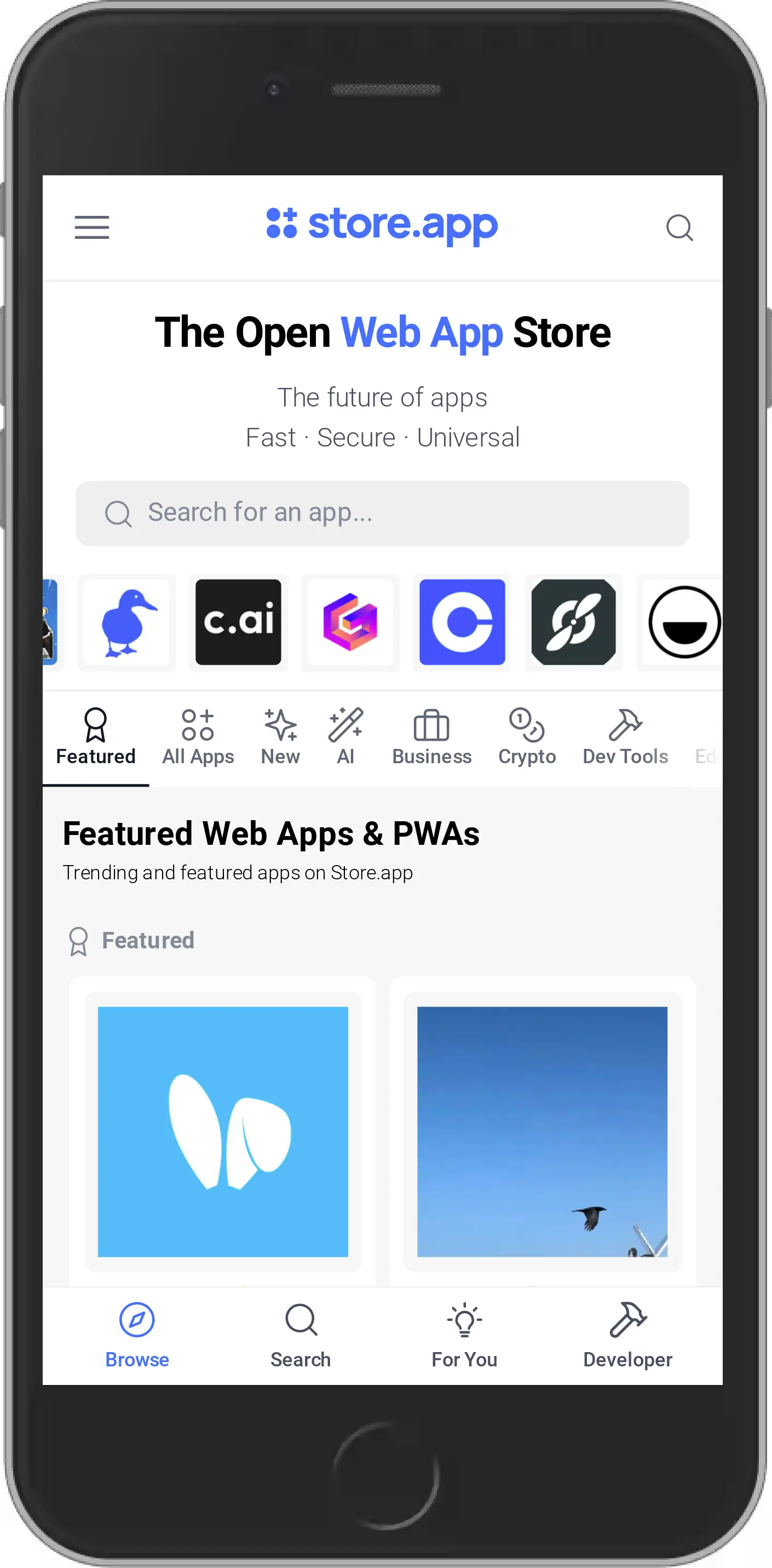
Work is also underway to give competing browsers a chance to facilitate PWAs that can install other PWAs. Web App Stores would then become a real possibility through browsers that support them, and we should expect that regulatory and legislative interventions will facilitate this in the near future. Removed from the need to police security (browsers have that covered) and handle distribution (websites update themselves), PWA app stores like store.app can become honest-to-goodness app management surfaces that can safely facilitate discovery and sync.

It's no surprise that Apple and Google have kept private the APIs needed to make this better future possible. They built the necessary infrastructure for the web to disrupt native, then kept it to themselves. This potential has remained locked away within organisations politically hamstrung by native app store agendas. But all of that is about to change.
This begs the question: where's the coverage? This is the most exciting moment in more than 15 years for the web vs. native story, but the tech press is whiffing it.
A New Hope
2024 will be packed to the gills with app store and browser news, from implementation of the DMA, to the UK's renewed push into mobile browsers and cloud gaming, to new legislation arriving in many jurisdictions, to the first attempts at shipping iOS ports of Blink and Gecko browsers. Each event is a chance to inform the public about the already-raging battle for the future of the phone.
It's still possible to reframe these events and provide better context. We need a fuller discussion about what it will mean for mobile OSes to have competing native app stores when the underlying OSes are foundationally insecure. There are also existing examples of ecosystems with this sort of choice (e.g., China), and more needs to be written about the implications for users and developers. Instead of nirvana, the insecure status quo of today's mobile OSes, combined with (even more) absentee app store purveyors, turns side-loading into an alternative form of lock-in, with a kicker of added insecurity for users. With such a foundation, the tech-buying public could understand why a browser's superior sandboxing, web search's better discovery, and frictionless links are better than dodgy curation side-deals and "beware of dog" sign security.
The more that folks understand the stakes, the more likely tech will genuinely change for the better. And isn't that what public interest journalism is for?
Thanks to Charlie, Stuart Langride, and Frances Berriman for feedback on drafts of this post.
FOOTNOTES
Antitrust is now a significant tech beat, and recent events frequently include browser choice angles because regulators keep writing regulations that will enhance it. This beat is only getting more intense, giving the tech press ample column inches to explain the status quo more deeply and and educate around the most important issues.
In just the last two months:
-
Google lost to Epic in a jury trial that determined Google's Play Store is an illegal monopoly.
-
Google lost all assumption of good faith as evidence from the Epic trial showed the Play team to be scoundrels, two-timers, and cretins who were willing to set shockingly unfair terms for anyone with enough market power to embarrass them. And that's before we get to the light attempted bribery.
-
Google's witness also blurted out a statistic that is both anodyne and damning: 36%. That's what Google pays Apple in search rev-share for default search placement in Safari. Normally, this would be a detail of a boring business deal. In context, however, it highlights Apple's decade-long suppression of iOS browser competition — combined with poverty-level funding of WebKit — which has skimmed tens of billions in profit per year from the web while starving browser development. This has deprived users, businesses, and web developers of safe (but critical) capabilities. It wasn't just Play that buggered the mobile web; Google was happy to outsource the dirty deed too.
-
Apple lost on an appeal to keep the UK's Competition and Market Authority (CMA) investigation into browsers and cloud gaming on ice.5
-
In December, Apple declined to appeal to the UK's Supreme Court for reasons that remain opaque.
Perhaps Apple didn't appeal because, in November, the UK unexpectedly brought forward the Digital Markets, Competition and Consumers Bill. It looks set to become law early in the new year, standing up a regulator with real teeth who, one presumes, will not be predisposed to think well of Apple's delay of its predecessor's investigations.
-
Meanwhile, in the EU, Apple attempted to wriggle out of regulations that might bring about proper browser choice by arguing that Safari is actually three under-performing browsers. in a marketing trenchcoat6.
-
On the other side of the planet, news just broke that Japan will bring forward legislation to target app store shenanigans. Given the JFTC's earlier findings about how interlocking layers of control have kept browsers from contesting app store prominence, we can expect some spicy legislative language around browsers.
-
Australia has also just agreed (in principle) to do the same, including language that acknowledges the role suppressing browser choice has had in preventing the web from competing with mobile native app ecosystems.
All but one of the 19 links above are from just the last 60 days, a period which includes a holiday break in the US and Europe. With the EU's DMA coming into force in March and the CMA back on the job, browser antitrust enforcement is only accelerating. It sure would be great if reporters could occasionally connect these dots. ⇐
-
The stories of how Apple and Google have kept browsers from becoming real app stores differ greatly in their details, but the effects have been nearly identical: only their browsers could offer installation of web apps, and those browsers have done shockingly little to support web developers who want to depend on the browser as the platform.
The ways that Apple has undermined browser-based stores is relatively well known: no equivalent to PWA install or "Smart Banners" for the web, no way for sites to suppress promotion of native apps, no ability for competing browsers to trigger homescreen installation until just this year, etc. etc. The decade-long build of Apple's many and varied attacks on the web as a platform is a story that's both tired and under-told.
Google's malfeasance has gotten substantially less airtime, even among web developers – nevermind the tech press.
The story picks up in 2017, two years after the release of PWAs and Push Notifications in Chrome. At the time, the PWA install flow was something of a poorly practised parlour trick: installation used an unreliable homescreen shortcut API that failed on many devices with OEM-customised launchers. The shortcut API also came laden with baggage that prevented effective uninstall and cross-device sync.
To improve this situation, "WebAPKs" were developed. This new method of installation allows for deep integration with the OS, similar to the Application Identity Proxy feature that Windows lets browsers to provide for PWAs, with one notable exception: on Android, only Chrome gets to use the WebAPK system.
Without getting into the weeds, suffice to say many non-Chrome browsers requested access. Only Google could meaningfully provide this essential capability across the Android ecosystem. So important were WebAPKs that Samsung gave up begging and reverse engineered it for their browser on Samsung devices. This only worked on Samsung phones where Suwon's engineers could count on device services and system keys not available elsewhere. That hasn't helped other browsers, and it certainly isn't an answer to an ecosystem-level challenge.
Without WebAPK API access, competing browsers can't innovate on PWA install UI and can't meaningfully offer PWA app stores. Instead, the ecosystem has been left to limp along at the excruciating pace of Chrome's PWA UI development.
Sure, Chrome's PWA support has been a damn sight better than Safari's, but that's just damning with faith praise. Both Apple and Google have done their part to quietly engineer a decade of unchallenged native app dominance. Neither can be trusted as exclusive stewards of web competitiveness. Breaking the lock on the doors holding back real PWA installation competition will be a litmus test for the effectiveness of regulation now in-flight. ⇐ ⇐
Push Notifications were, without exaggeration, the single most requested mobile Safari feature in the eight years between Chromium browsers shipping and Apple's 2023 capitulation.
It's unedifying to recount all of the ways Apple prevented competing iOS browsers from implementing Push while publicly gaslighting developers who requested this business-critical feature. Over and over and over again. It's also unhelpful to fixate on the runarounds that Apple privately gave companies with enough clout to somehow find an Apple rep to harangue directly. So, let's call it water under the bridge. Apple shipped, so we're good, right?
Right?
I regret to inform you, dear reader, that it is not, in fact, "good".
Despite most of a decade to study up on the problem space, and nearly 15 years of of experience with Push, Apple's implementation is anything but complete.
The first few releases exposed APIs that hinted at important functionality that was broken or missing. Features as core as closing notifications, or updating text when new data comes in. The implementation of Push that Apple shipped could not allow a chat app to show only the latest message, or a summary. Instead, Apple's broken system leaves a stream of notifications in the tray for every message.
Many important features didn't work. Some still don't.. And the pathetic set of customisations provided for notifications are a sick, sad joke.
Web developers have once again been left to dig through the wreckage to understand just how badly Apple's cough "minimalist" cough implementation is compromised. And boy howdy, is it bad.
Apple's implementation might have passed surface-level tests (gotta drive up that score!), but it's unusable for serious products. It's possible to draw many possible conclusions from this terrible showing, but even the relative charity of Hanlon's Razor is damning.
Nothing about this would be worse than any other under-funded, trailing-edge browser over the past three decades (which is to say, a bloody huge problem), except for Apple's well-funded, aggressive, belligerent ongoing protest to every regulatory attempt to allow true browser choice for iPhone owners.
In the year 2024, you can have any iOS browser you like. You can even set them as default. They might even have APIs that look like they'll solve important product needs, but as long as they're forced to rely on Apple's shit-show implementation, the web can't ever be a competitive platform.
When Apple gets to define the web's potential, the winner will always be native, and through it, Apple's bottom line. ⇐
The muting effect of Apple's abuse of monopoly over wealthy users to kneecap the web's capabilities is aided by the self-censorship of web developers. The values of the web are a mirror world to native, where developers are feted for adopting bleeding-edge APIs. On the web, features aren't "available" until 90+% of all users have access to them. Because iOS is at least 20% of the pie), web developers don't go near features Apple fails to support. Which is a lot.
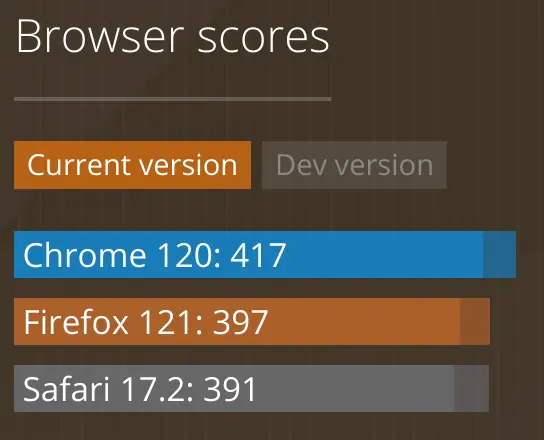
caniuse.com's "Browser Score" is one way to understand the scale of the gap in features that Apple has forced on all iOS browsers. 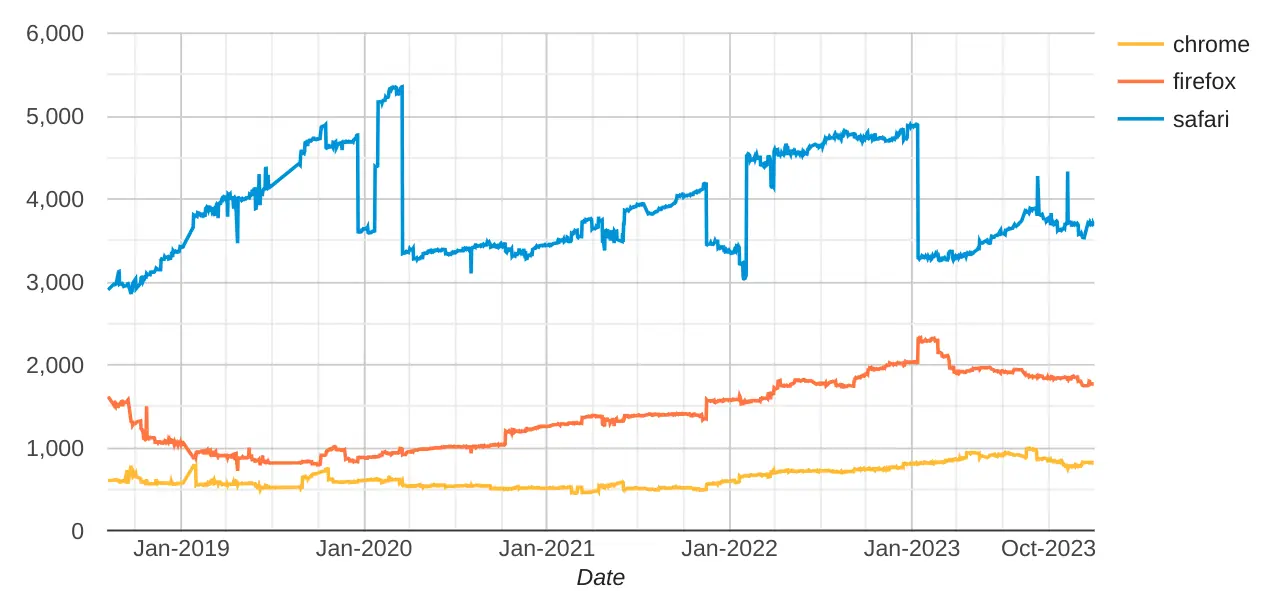
The Web Platform Tests dashboard highlights 'Browser Specific Failures', which only measure failures in tests for features the browser claims to support. Not only are iOS browsers held back by Apple's shockingly poor feature support, but the features that _are_ available are broken so often that many businesses feel no option but to retreat to native APIs that Apple doesn't break on a whim, forcing the logic of the app store on them if they want to reach valuable users. Apple's pocket veto over the web is no accident, and its abuse of that power is no bug.
Native app stores can only take an outsized cut if the web remains weak and developers stay dependent on proprietary APIs to access commodity capabilities. A prohibition on capable engines prevents feature parity, suppressing competition. A feature-poor, unreliable open web is essential to prevent the dam from breaking.
Why, then, have competing browser makers played along? Why aren't Google, Mozilla, Microsoft, and Opera on the ramparts, waving the flag of engine choice? Why do they silently lend their brands to Apple's campaign against the web? Why don't they rename their iOS browsers to "Chrome Lite" or "Firefox Lite" until genuine choice is possible? Why don't they ask users to write their representatives or sign petitions for effective browser choice? It's not like they shrink from it for other worthy causes.
I'm shocked by not surprised by the tardiness of browser bosses to seize the initiative. Instead of standing up to unfair terms, they've rolled over time and time again. It makes a perverse sort of sense.
More than 30 years have passed since we last saw effective tech regulation. The careers of those at the top have been forged under the unforgiving terms of late-stage, might-makes-right capitalism, rather than the logic of open markets and standards. Today's bosses didn't rise by sticking their necks above the parapets to argue virtue and principle. At best, they kept the open web dream alive by quietly nurturing the potential of open technology, hoping the situation would change.
Now it has, and yet they cower.
Organisations that value conflict aversion and "the web's lane is desktop" thinking get as much of it as they care to afford. ⇐
Recall that Apple won an upset victory in March after litigating the meaning of the word "may" and arguing that the CMA wasn't wrong to find after multiple years of investigations that Apple were (to paraphrase) inveterate shitheels, but rather that the CMA waited too long (six months) to bring an action which might have had teeth.
Yes, you're reading that right; Apple's actual argument to the Competition Appeal Tribunal amounted to a mashup of rugged, free-market fundamentalist " but mah regulatory certainty!", performative fainting into strategically placed couches, and feigned ignorance about issues it knows it'll have to address in other jurisdictions.
Thankfully, the Court of Appeals was not to be taken for fools. Given the harsh (in British) language of the reversal, we can hope a chastened Competition Appeal Tribunal will roll over less readily in future. ⇐
If you're getting the sense that legalistic hair-splitting is what Apple spends its billion-dollar-per-year legal budget on because it has neither the facts nor real benefits to society on its side, wait 'till you hear about some of the stuff it filed with Japan's Fair Trade Commission!
A clear strategy is being deployed. Apple:
- First claims there's no there there (pdf). When that fails...
- Claims competitors that it has expressly ham-strung are credible substitutes. When that fails...
- Claims security would suffer if reasonable competition were allowed. Rending of garments is performed while prophets of doom recycle the script that the sky will fall if competing browsers are allowed (which would, in turn, expand the web's capabilities). Many treatments of this script fill the inboxes of regulators worldwide. When those bodies investigate, e.g. the history of iOS's forced-web-monoculture insecurity, and inevitably reject these farcical arguments, Apple...
- Uses any and every procedural hurdle to prevent intervention in the market it has broken.
The modern administrative state indulges firms with "as much due process as money can buy", and Apple knows it, viciously contesting microscopic points. When bluster fails, huffingly implemented, legalistic, hair-splitting "fixes" are deployed on the slowest possible time scale. This strategy buys years of delay, and it's everywhere: browser and mail app defaults, payment alternatives, engine choice, and right-to-repair. Even charging cable standardisation took years longer than it should have thanks to stall tactics. This maximalist, joined-up legal and lobbying strategy works to exhaust regulators and bamboozle legislators. Delay favours the monopolist.
A firm that can transform the economy of an entire nation just by paying a bit of the tax it owes won't even notice a line item for lawyers to argue the most outlandish things at every opportunity. Apple (correctly) calculates that regulators are gun-shy about punishing them for delay tactics, so engagement with process is a is a win by default. Compelling $1600/hr white-shoe associates to make ludicrous, unsupportable claims is a de facto win when delay brings in billions. Regulators are too politically cowed and legally ham-strung to do more, and Apple plays process like a fiddle. ⇐
What I did in 2023
2023: Year in review
Hello! This was my 4th year working full time on Wizard Zines! Here are a few of the things I worked on this year.
a zine!
I published How Integers and Floats Work, which I worked on with Marie.
This one started out its life as “how your computer represents things in memory”, but once we’d explained how integers and floats were represented in memory the zine was already long enough, so we just kept it to integers and floats.
This zine was fun to write: I learned about why signed integers are represented in memory the way they are, and I’m really happy with the explanation of floating point we ended up with.
a playground: memory spy!
When explaining to people how your computer represents people in memory, I kept
wanting to open up gdb or lldb and show some example C programs and how the
variables in those C programs are represented in memory.
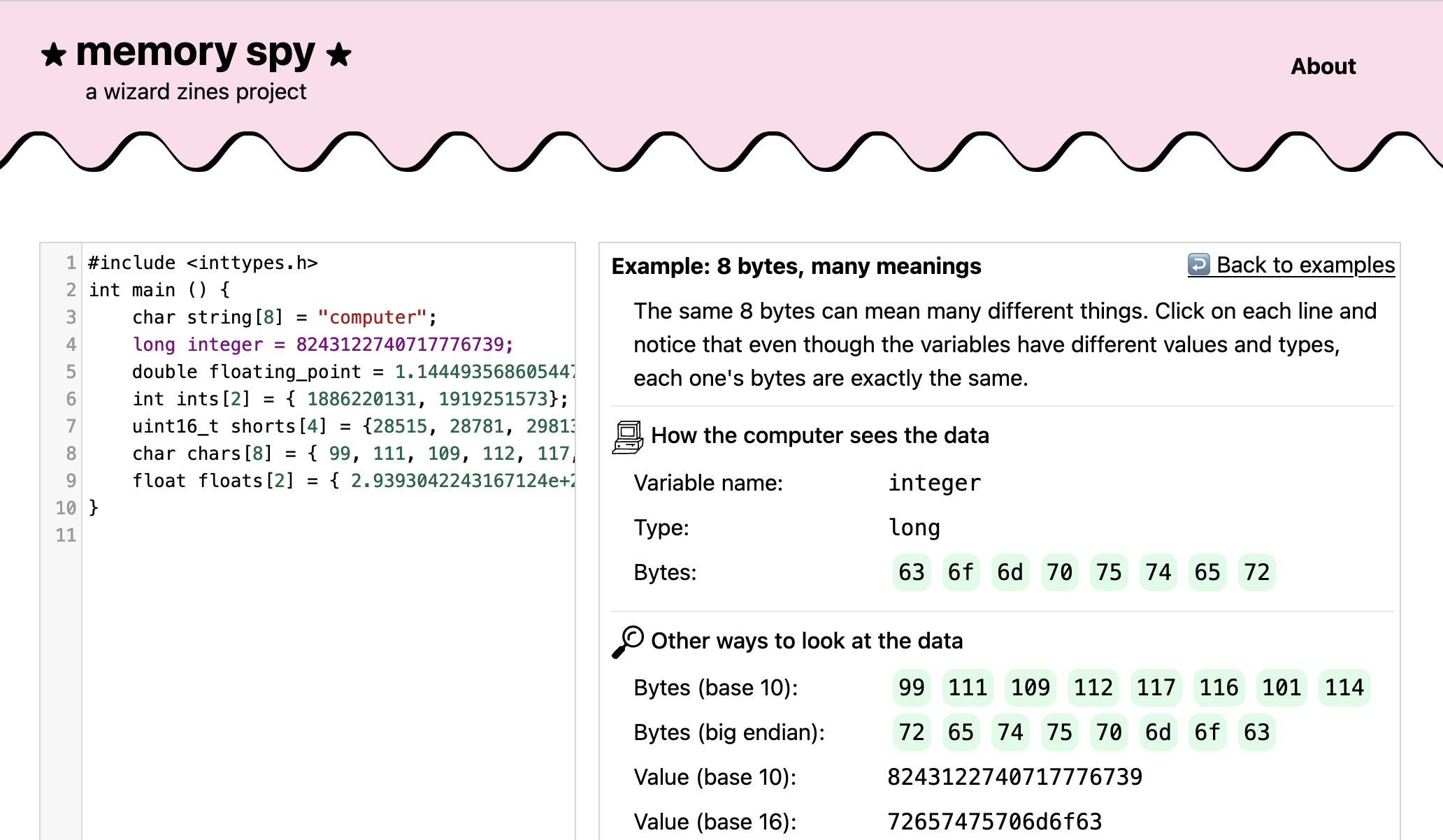
But gdb is kind of confusing if you’re not used to looking at it! So me and
Marie made a cute interface on top of lldb, where you can put in any C program,
click on a line, and see what the variable looks like. It’s called memory spy and here’s what it looks like:
a playground: integer exposed!
I got really obsessed with float.exposed by Bartosz Ciechanowski for seeing how floats are represented in memory. So with his permission, I made a copy of it for integers called integer.exposed.
Here’s a screenshot:
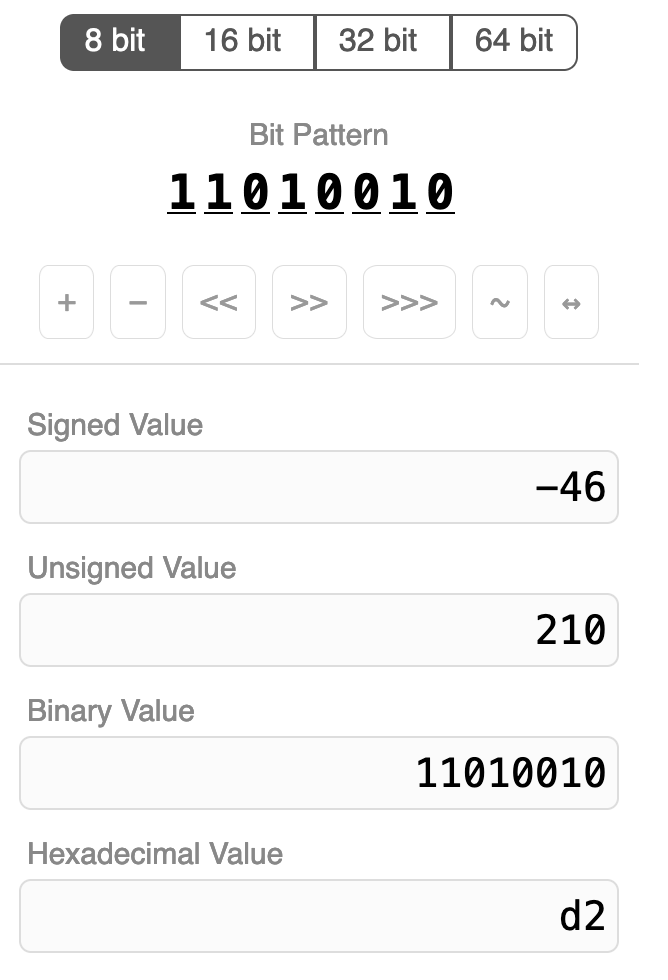
It was pretty straightforward to make (copying someone else’s design is so much easier than making your own!) but I learned a few CSS tricks from analyzing how he implemented it.
Implement DNS in a Weekend
I’ve been working on a big project to show people how to implement a working networking stack (TCP, TLS, DNS, UDP, HTTP) in 1400 lines of Python, that you can use to download a webpage using 100% your own networking code. Kind of like Nand to Tetris, but for computer networking.
This has been going VERY slowly – writing my own working shitty implementations was relatively easy (I finished that in October 2022), but writing clear tutorials that other people can follow is not.
But in March, I released the first part: Implement DNS in a Weekend. The response was really good – there are dozens of people’s implementations on GitHub, and people have implemented it in Go, C#, C, Clojure, Python, Ruby, Kotlin, Rust, Typescript, Haskell, OCaml, Elixir, Odin, and probably many more languages too. I’d like to see more implementations in less systems-y languages like vanilla JS and PHP, need to think about what I can do to encourage that.
I think “Implement IPv4 in a Weekend” might be the next one I release. It’s going to come with bonus guides to implementing ICMP and UDP too.
a talk: Making Hard Things Easy!
I gave a keynote at Strange Loop this year called Making Hard Things Easy (video + transcript), about why some things are so hard to learn and how we can make them easier. I’m really proud of how it turned out.
a lot of blog posts about Git!
In September I decided to work on a second zine about Git, focusing more on how Git works. This is one of the hardest projects I’ve ever worked on, because over the last 10 years of using it I’d completely lost sight of what’s hard about Git.
So I’ve been doing a lot of research to try to figure out why Git is hard, and I’ve been writing a lot of blog posts. So far I’ve written:
- In a git repository, where do your files live?
- Some miscellaneous git facts
- Confusing git terminology
- git rebase: what can go wrong?
- How git cherry-pick and revert use 3-way merge
- git branches: intuition & reality
- Mounting git commits as folders with NFS
What’s been most surprising so far is that I originally thought “to understand Git, people just need to learn git’s internal data model!”. But the more I talk to people about their struggles with Git, the less I think that’s true. I’ll leave it at that for now, but there’s a lot of work still to do.
some Git prototypes!
I worked on a couple of fun Git tools this year:
- git-commit-folders: a way to mount your Git commits as (read-only) folders using FUSE or NFS. This one came about because someone mentioned that they think of Git commits as being folders with old versions of the code, and it made me wonder – why can’t you just have a virtual folder for every commit? It turns out that it can and it works pretty well.
- git-oops: an experimental prototype of an
undo system for git. This one came out of me wondering “why can’t we just
have a
git undo?”. I learned a bunch of things about why that’s not easy through writing the prototype, I might write a longer blog post about it later.
I’ve been trying to put a little less pressure on myself to release software that’s Amazing and Perfect – sometimes I have an idea that I think is cool but don’t really have the time or energy to fully execute on it. So I decided to just put these both on Github in a somewhat unfinished state, so I can come back to them if later if I want. Or not!
I’m also working on another Git software project, which is a collaboration with a friend.
hired an operations manager!
This year I hired an Operations Manager for Wizard Zines! Lee is incredible and has done SO much to streamline the logistics of running the company, so that I can focus more on writing and coding. I don’t talk much about the mechanics of running the business on here, but it’s a lot and I’m very grateful to have some help.
A few of the many things Lee has made possible:
- run a Black Friday sale!
- we added a review system to the website! (it’s so nice to hear about how people loved getting zines for Christmas!)
- the store has been reorganized to be way clearer!
- we’re more consistent about sending out the new comics newsletter!
- I can take a vacation and not worry about support emails!
migrated to Mastodon!
I spent 10 years building up a Twitter presence, but with the Recent Events, I spent a lot of time in 2023 working on building up a Mastodon account. I’ve found that I’m able to have more interesting conversations about computers on Mastodon than on Twitter or Bluesky, so that’s where I’ve been spending my time. We’ve been having a lot of great discussions about Git there recently.
I’ve run into a few technical issues with Mastodon (which I wrote about at Notes on using a single-person Mastodon server) but overall I’m happy there and I’ve been spending a lot more time there than on Twitter.
some questions for 2024
one of my questions for 2022 was:
- What’s hard for developers about learning to use the Unix command line in 2022? What do I want to do about it?
Maybe I’ll work on that in 2024! Maybe not! I did make a little bit of progress on that question this year (I wrote What helps people get comfortable on the command line?).
Some other questions I’m thinking about on and off:
- Could man pages be a more useful form of documentation? Do I want to try to do anything about that?
- What format do I want to use for this “implement all of computer networking in Python” project? (is it a website? a book? is there a zine? what’s the deal?) Do I want to run workshops?
- What community guidelines do I want to have for discussions on Mastodon?
- Could I be marketing Mess With DNS (from 2021) more? How do I want to do that?
moving slowly is okay
I’ve started to come to terms with the fact that projects always just take longer than I think they will. I started working this “implement your own terrible networking stack” project in 2022, and I don’t know if I’ll finish it in 2024. I’ve been working on this Git zine since September and I still don’t completely understand why Git is hard yet. There’s another small secret project that I initally thought of 5 years ago, made a bunch of progress on this year, but am still not done with. Things take a long time and that’s okay.
As always, thanks for reading and for making it possible for me to do this weird job.