Reading List
The most recent articles from a list of feeds I subscribe to.
Breadcrumbs, buttons and buy-in: Patterns Day 3
Yesterday I spent all day in a cinema full of design system nerds. Why? To attend Patterns Day 3. Eight speakers shared their knowledge: some zoomed out to see the bigger picture, others zoomed in on the nitty-gritty.
It was nice to be at another Patterns Day, after I attended the first and missed the second. Thanks Clearleft and especially Jeremy Keith for putting it together. In this post, I'll share my takeaways from the talks, in four themes: the design system practice, accessibility, the technical nitty-gritty, and communication.
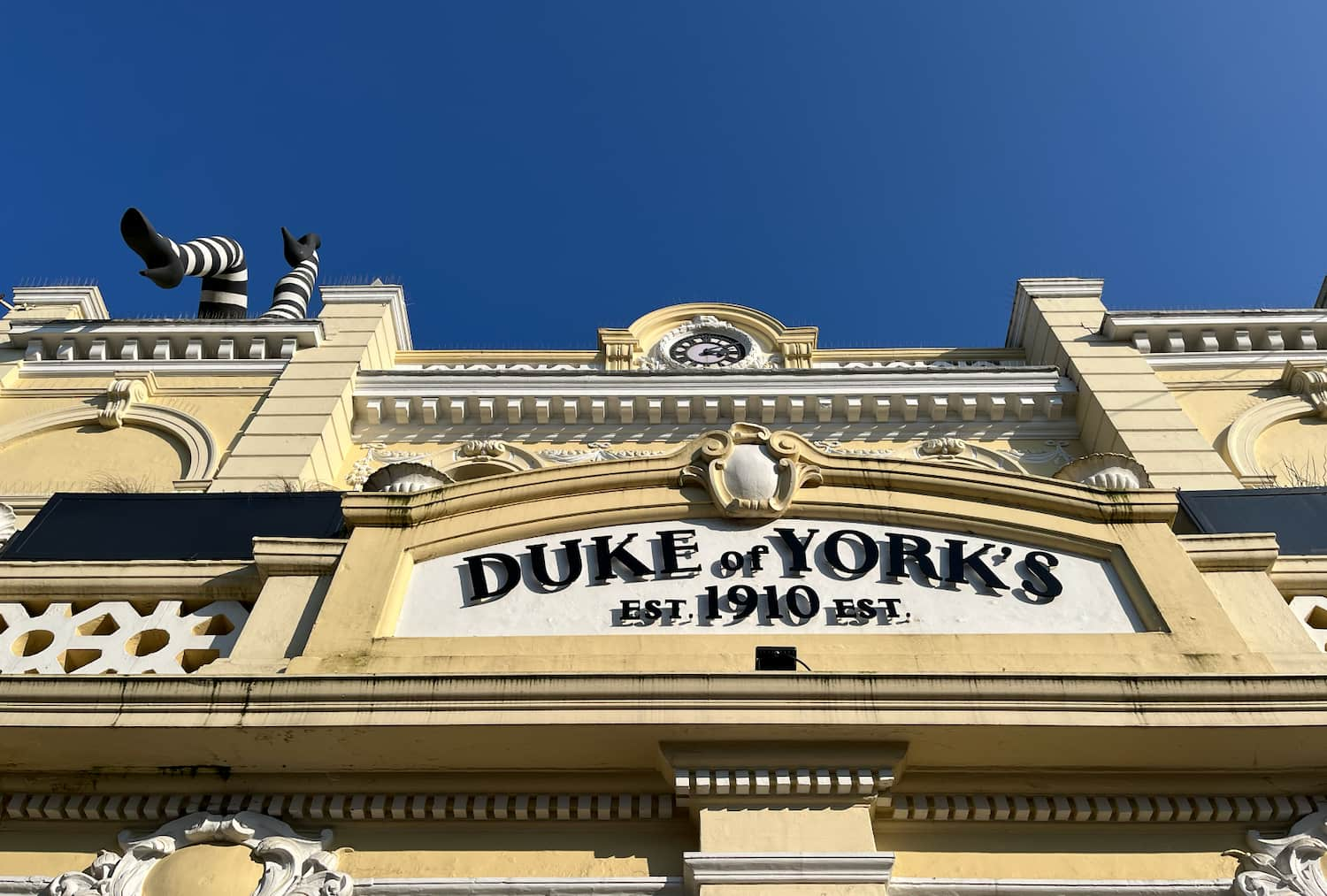 The day's venue: the Duke of York's cinema
The design system practice
Design system veteran Jina Anne, inventor of design tokens, opened the day with a reflection on over a decade of design systems (“how many times can I design a button in my career?”) and a look at the future. She proposed we find a balance between standardisation and what she called “intelligent personalisation”.
On the other hand, we aren't really done yet. There are so many complex UX patterns that can be solved more elegantly, as Vitaly Friedman showed. His hobbies include browsing postal office, governmental and e-commerce websites. He looks at the UIs they invent (so that we don't have to). Vitaly showed us more breadcrumbs than was necessary, including some that, interestingly, have feature-parity with meganavs.
Yolijn van der Kolk, product manager (and my colleague) at NL Design System, presented a unique way of approaching the design system practice: the “relay model”. It assigns four statuses to components and guidelines, which change over time on their road to standardisation. It allows innovation and collaboration from teams with wildly different needs in wildly different organisations. The statuses go from sharing a need (“Help Wanted”), to materialising it with a common architecture and guidelines (“Community”), to proposing it for real-life feedback (“Candidate”), to ultimately standardising an uncontroversial and well-tested version of it (”Hall of Fame”).
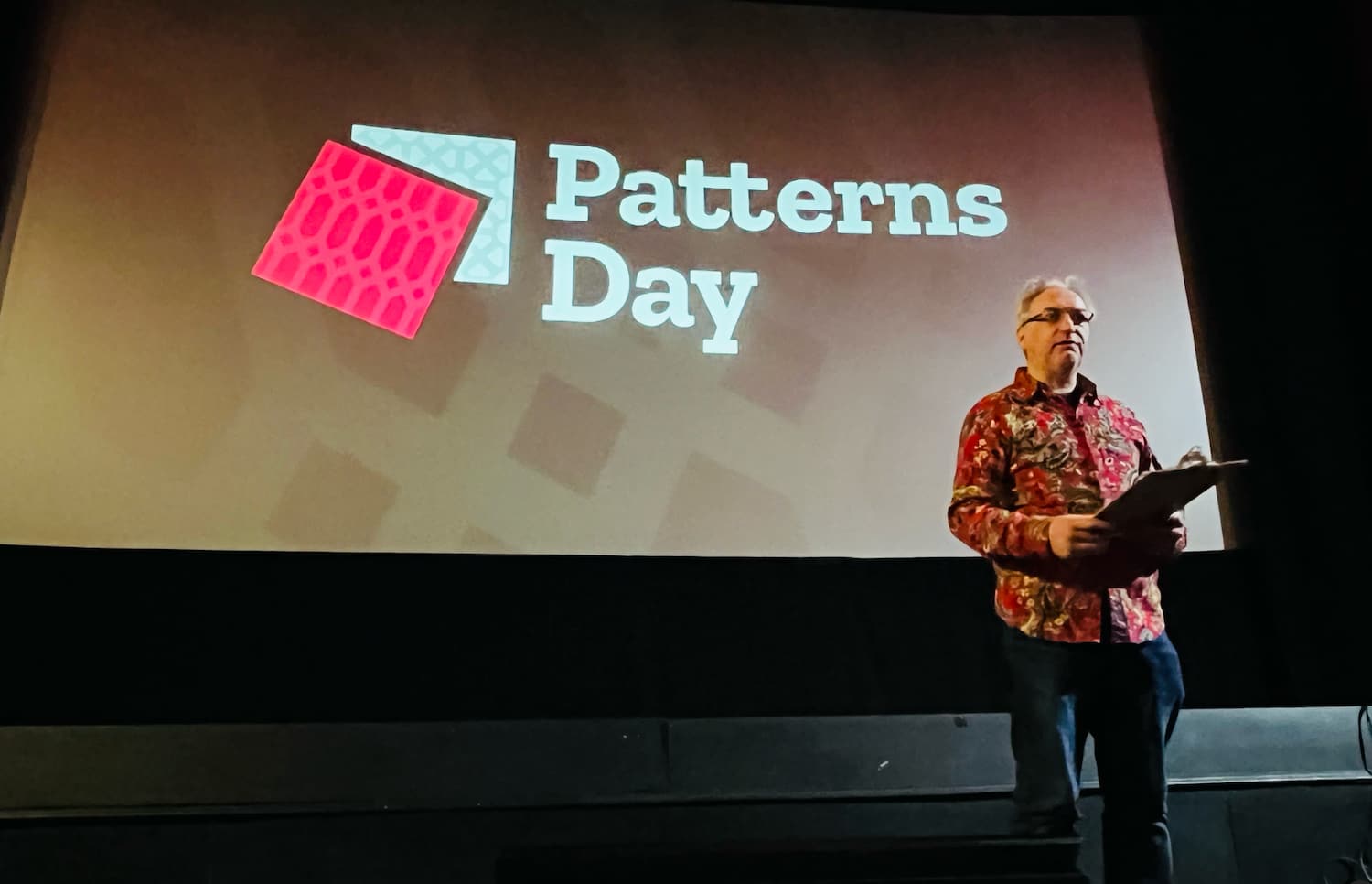 Jeremy Keith hosted the event
The technical nitty gritty
Two talks focused on design problems that can be solved with clever technical solutions: theming (through design tokens) and typography (through modular scales with modern CSS).
Débora Ornellas, who worked at Lego (haven't we all used the analogy?), shared a number of great recommendations around using design tokens: to use readily available open source products instead of inventing your own, publish tokens as packages and version them and avoid migration fatigue by reducing breaking changes.
Richard Rutter of Clearleft introduced us to typographic scales, which, he explained, are like musical scales. I liked how, after he talked about jazz for a bit, the venue played jazz in the break after his talk. He showed that contrast (eg in size) between elements is essential for good typography: it helps readers understand information hierarchy. How much depends on various factors, like screen size, but to avoid having to maintain many different scales, he proposed a typographic scale that avoids breakpoints, by using modern CSS features like clamp() (or a CSS locks based alternative if you don't want to risk failing WCAG 1.4.4). I suggest checking out Utopia to see both strategies in action.
Accessibility, magic and the design system
The power of design systems is that they can make it easier to repeat good things, such as well-engineered components. And they can repeat accessibility, but there is a lot of nuance, because that won't work magically.
Geri Reid (seriously, more conference organisers should invite Geri!) warned us about the notion that a design system will “fix” the accessibility of whichever system consumes it. Sounds like magic, and too good to be true? Yup, because what will inevitably happen, Geri explained, is that teams start using the “accessible” components to make inaccessible things. Yup, I have definitely seen this over and over.
To mitigate this risk of “wrong usage”, she explained, we need design systems to not just deliver components, but set standards and do education, too. At which point the design system can actually help build more accessible sites. For instance, if components contain ARIA, it's essential that the consumers of those components know how to configure that ARIA. In other words, design systems need very good documentation. Which brings me to the last theme: common understanding and why it matters.
Mitigating misunderstandings with better communication
The theme that stood out to me on the day: design system teams commonly have to deal with misunderstandings. Good communication is important. What a cliché, you might say, that's like anyone in any job. Yes, but it's specifically true for our field: design systems force collaboration between such a broad range of people. That includes similar-discipline-collaboration, like between designer and developer. Débora explained what can happen if they don't work together closely, or if breaking changes aren't communicated timely.
But it's also about wider collaboration: a design system team also needs to make sense to other departments, that have specific requirements and norms. Including those that don't really grasp all the technical details of front-end componentisation, like marketing or (non-web) brand teams, or the people who can help sponsor or promote the project. Samantha Fanning from UCL focused on this in her talk on “design system buy-in”, which she had a lot of useful tips about. She recommended to involve other departments early to do “co-design” rather than presenting (and surprising) them with a finished product. She also shared how it helped her to add design system work as extra scope onto existing projects, rather than setting up a design system specific project.
In her talk, Mary Goldservant of the Financial Times, also touched on the importance of communication. She shared how they got feedback from stakeholders and manage expectations, while working on a large update to Origami, the Financial Times' brilliantly named design system, that includes lots of changes, like multi-brand and multi-platform support.
Wrapping up
It was nice to hang out with so many like-minded folks and learn from them. A lot of the challenges, tools and ideas resonated. Once again, I've realised our problems aren't unique and many of us are in similar struggles, just in slightly different ways.
Originally posted as Breadcrumbs, buttons and buy-in: Patterns Day 3 on Hidde's blog.
Kirby apps and regressive enhancements
"No way to prevent this" say users of only language where this regularly happens
Modals and mysterious macOS failures
My loss. Their public consumption.
Growing up, I wasn’t close to my extended family. My parents weren’t close to them or were not on speaking terms, so, as a child, I followed their pattern. It probably explains why it took until recently for me to experience grieving while online.
I just flew back from Portugal, having spent the first anniversary of my father’s death with my mum and sister. I don’t know if I am lying to myself but I feel that I’ve accepted some things that panned out at the time.
I started this draft in August 2023, just before I started to struggle a lot mentally, and I really want to talk about what happened online after my dad passed away.
I grew up in a small town, and my dad was popular. He was born and lived in the area all his life and was heavily involved in the community. So, his death was a shock to everyone. The news had already spread by the time I landed in Portugal the following morning. The funeral agency that handled his passing immediately shared it via printed posters on all the local businesses and their own Facebook page. This is what usually happens over there.
I think that because he was catholic, it meant that his vigil would generally be the day immediately after his passing and then a funeral. However, due to the reasons why he passed, my dad’s body was not suitable to be seen by anyone. This isn’t normal there, so people immediately became curious and shamelessly intrigued and inquisitive. His body was cremated, and we didn’t do the traditional vigil. We had a vigil and funeral on the same day, two days after his passing.
After landing and travelling to see my mum, I opened my phone. I decided to share on my Facebook account (which I never use) where and when the vigil and funeral would be if anyone wished to attend. I decided to share a link to the funeral home’s website with the latest information. But as I opened Facebook, I could already see it everywhere. My body felt a shiver as I saw the original post of the funeral home already with dozens of comments, dozens more shares and reactions.
Most comments were sending condolences and expressing their shock at the news. But of course, the nosy people are also online. Comments like “Why can’t we see his body?”, “What did he die of?” gave me a glimpse of what families of crime victims feel like when people speculate online. I couldn’t stop scrolling. I would click on their profile to see if they were Facebook friends with my dad. I wanted to understand their rationale for thinking it was appropriate to ask such things. I remember one comment that said something along the lines of “Oh, I don’t recognise him”, and then someone else replied, “It’s [my mum’s name]’s husband.” while tagging my mum. I wanted to scream. I wanted to teach them manners. But I just froze.
That evening, I was tasked with deleting his social media accounts. His phone was still vibrating from all the group chats he was in and from getting calls. It was strange. I know this isn’t a unique experience, but like I said, I have never dealt with it before.
I entered his Facebook account, downloaded his photos and attempted to delete the account. I don’t remember the details now, but it was extremely difficult to delete his Instagram account. I think I did it right. I haven’t had the guts to check yet. It was a long day, and I went to sleep.
The following day, during his vigil, I went outside the chapel to greet a friend. I had someone come up to me, all cheerful, asking me, unknowing that I was his daughter, who exactly was he. “My father”, I said with an awkward, pleasant tone.
“Oh. He was young,” she replied.
“I know.”
I could hear the whispers of people gossiping over the alleged state of his body. They said the “funeral home” was shocked and had never seen anything like it. I was sore, but I couldn’t make a scene.
The evening after the funeral, I checked his phone. I shouldn’t, but I read the unread messages. He was in a group chat, and I saw someone breaking the news to the whole group. Their reactions, shock, confusion, them wondering about us, them organising a funeral bouquet. Then, a random question about something else (I don’t remember what), and the reply was, “What should we do about his number here? His daughters might be getting all these messages”. They didn’t know what to do. I suppose none of them wanted to remove him from the group, but it was haunting at the time. Someone brought back his last message to the group. There were messages about what they would bring to the funeral, when to meet up, etc.
Then, after the funeral, someone asked about a dinner and drinks they had arranged before this all happened and what the plans were. I had reached the bottom of the group chat. Life carried on for everyone (as it should). I removed him from the group and hoped it allowed them to talk freely and carry on.
While everyone was asleep, I went back to Facebook to check the latest tattle. Then I shared on my own profile a handful of tributes shared on Facebook by the communities he was involved in and employers.
I was angry because he deserved more respect and dignity in this death. And while I am thankful to the hundreds who attended and paid their respects, I am seething over the ones who wanted to be entertained.
While life seemed to have stopped for us, it didn’t for everyone else. Soon after, another tragedy struck someone in the town, and now they were in the spotlight instead. I pushed back my feelings and focused on supporting my mum.
Two weeks later, I needed to find something, so I remembered that I had shared it on my Facebook profile, and since I so rarely post, I would be super quick to find it. It was. But by scrolling through my own profile, I also saw that his employer removed their tribute post.
I guess it didn’t match the aesthetic.