Reading List
The most recent articles from a list of feeds I subscribe to.
UCB pays up to $2.2bn for Candid Therapeutics, doubling down on T-cell engagers in autoimmune disease
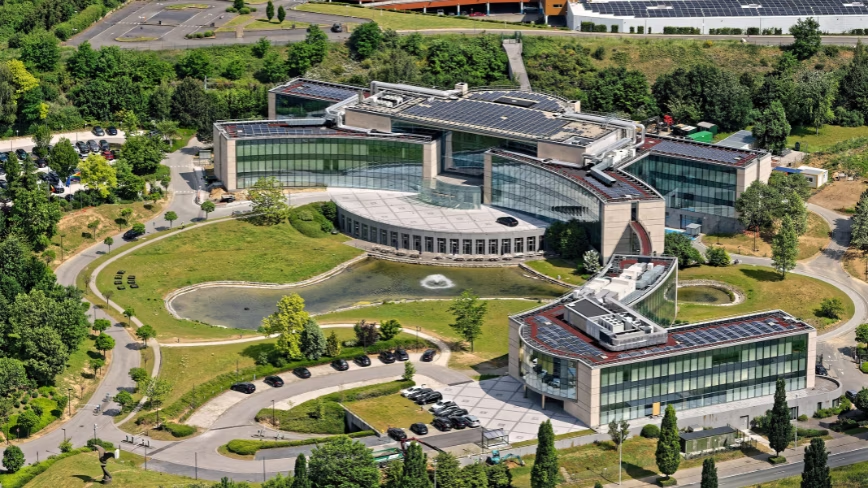
The Belgian pharma is buying a two-year-old San Diego biotech for $2bn upfront, the second TCE bet it has placed in months. The thesis: B-cell killers built for cancer can rewire how autoimmune diseases are treated. Candid Therapeutics is two years old. It does not have an approved drug. Its lead programme has been tested […]
This story continues at The Next Web
Jensen Huang said Nvidia's market share of AI accelerators in China has "now dropped to zero" and that the US' export policy "has already largely backfired" (Anton Shilov/Tom's Hardware)

 Anton Shilov / Tom's Hardware:
Jensen Huang said Nvidia's market share of AI accelerators in China has “now dropped to zero” and that the US' export policy “has already largely backfired” — US export restrictions bite. … Nvidia CEO Jensen Huang said that the company's market share of AI accelerators in China has now dropped to 0%.
Cerebras seeks a valuation of up to $26.62B in its US IPO, aiming to raise $3.5B by selling 28M shares at $115 to $125 apiece in its second attempt to go public (Reuters)

Reuters:
Cerebras seeks a valuation of up to $26.62B in its US IPO, aiming to raise $3.5B by selling 28M shares at $115 to $125 apiece in its second attempt to go public — Nvidia-rival Cerebras is seeking a valuation of as much as $26.62 billion in its U.S. initial public offering …
Legislators and experts criticize the EU's €20B sovereign compute data center plan, questioning whether there is demand and the plan's reliance on Nvidia GPUs (Pieter Haeck/Politico)

Pieter Haeck / Politico:
Legislators and experts criticize the EU's €20B sovereign compute data center plan, questioning whether there is demand and the plan's reliance on Nvidia GPUs — BRUSSELS — A €20 billion European Union plan to build massive artificial intelligence computing hubs is drawing widespread criticism ahead of launch.
An analysis of 1.6M Polymarket accounts since November 2022: 0.1% of users get 67% of the profits, with the highest-frequency traders seeing the most success (Wall Street Journal)

Wall Street Journal:
An analysis of 1.6M Polymarket accounts since November 2022: 0.1% of users get 67% of the profits, with the highest-frequency traders seeing the most success — A WSJ analysis shows a small number of accounts on Polymarket and Kalshi—often pros using data-driven algorithmic trading—take home most of the winnings